Commercial Smoothie Machines for Cafes, Gyms & Juice Bars
Smoothies can place significant demands on commercial blending equipment. Frozen fruit, ice, leafy greens, nut butters, powders, and other ingredients need to be processed quickly and consistently, often during periods when orders arrive back to back.
A commercial smoothie machine is designed for this type of foodservice environment. For cafes, juice bars, gyms, restaurants, hotels, and other businesses serving blended beverages, choosing the right machine can support drink consistency, efficient preparation, and dependable day-to-day operation.
The best choice depends on more than blending power alone. Daily volume, menu complexity, available counter space, noise, cleaning requirements, and service support can all influence which commercial smoothie machine is appropriate for an operation.
Key takeaways
Commercial smoothie machines are designed to handle the workload and operational demands of foodservice environments.
Daily drink volume, menu ingredients, durability, cleaning requirements, and noise are important considerations when selecting a machine.
Features such as programmable blending settings can help businesses improve consistency and simplify drink preparation across employees and shifts.
Proper staff training, cleaning, container use, and routine maintenance help support reliable performance over time.
What is a commercial smoothie machine?
A commercial smoothie machine is a blender designed for professional foodservice use, particularly for preparing smoothies and other blended beverages repeatedly throughout the day. Unlike equipment intended primarily for occasional household blending, commercial machines must fit into workflows where speed, repeatability, durability, and ease of operation can directly affect service.
Smoothie applications can be especially demanding because recipes frequently combine frozen and fresh ingredients with liquids, powders, ice, and other components. A commercial machine should be selected with those applications and the business's expected volume in mind.
The term can cover equipment used in dedicated smoothie businesses as well as commercial blenders that support broader menus. A cafe might use the same machine for smoothies and other blended drinks, for example, while a juice bar may depend on blending equipment throughout most of its operating hours.
Businesses serving blended beverages need equipment suited to both their recipes and their operating environment. A machine that produces a satisfactory drink but slows service, creates inconsistent results, or requires frequent attention can become a bottleneck during busy periods.
Consistent blending performance
Consistency matters when customers expect the same drink each time they order. A commercial smoothie machine should be capable of processing the ingredients used in the business's recipes and producing repeatable results when recipes and operating procedures are followed consistently.
This becomes particularly important for businesses with multiple employees or shifts. Standardized recipes, proper ingredient loading, and appropriate blending procedures can help reduce variation in texture and preparation.
Faster drink preparation
Preparation speed affects both customers and staff. During a morning rush at a cafe or a busy period at a juice bar, several smoothie orders may need to move through the station in quick succession.
Commercial blending equipment can support an efficient workflow when the machine, recipes, ingredient station, and staff procedures are designed to work together. Faster blending is only part of the equation. Employees also need to be able to load ingredients, operate the machine, remove the finished drink, and prepare the equipment for the next order efficiently.
Built for high-volume operation
Commercial foodservice equipment is designed around professional operating conditions. For a smoothie program, that can mean repeated blending cycles throughout a shift and recipes containing challenging ingredients such as ice and frozen produce.
Volume requirements vary considerably by business. A restaurant offering a few smoothies alongside a larger menu has different demands from a juice bar where blended beverages account for much of the day's sales. Understanding expected volume helps businesses choose equipment suited to their actual workload.
Reduced downtime and maintenance
Equipment downtime can interrupt service and place additional pressure on employees, especially when blending is central to the menu. Selecting commercial equipment designed for the intended application can help businesses build a more dependable beverage station.
Maintenance still matters. Proper operation, regular cleaning, appropriate container use, and routine inspection all contribute to reliable equipment performance. Businesses should also consider access to warranty and service support when evaluating a commercial smoothie machine.
Choosing the right commercial smoothie machine
The right machine should reflect how the business actually operates. Rather than evaluating equipment on a single feature, consider the complete blending workload and how the machine will fit into daily service.
Consider your daily drink volume
Start with the number of blended drinks the business expects to prepare, including peak periods rather than only daily averages. A location may have modest overall volume but experience concentrated demand before work, around lunch, after fitness classes, or during other predictable rushes.
Consider how many drinks need to be prepared consecutively and whether one blending station can keep pace. Businesses expecting growth should also consider whether their equipment choice can support anticipated increases in demand.
Evaluate menu offerings
Ingredients and recipes affect equipment requirements. Smoothies containing frozen fruit and ice can create different blending demands than drinks based primarily on liquids and powders. A menu may also include leafy greens, nut butters, seeds, or other ingredients that need to be incorporated smoothly.
Look beyond the current menu when appropriate. If the business expects to add blended beverages or other applications, selecting equipment that supports those plans can make the blending station more useful over time.
Look for durability and reliability
A commercial smoothie machine may operate repeatedly throughout the day, so durability should be considered in the context of the expected workload. Evaluate the machine as a complete system, including the motor base, controls, containers, lids, and other components used regularly by staff.
Reliability also has an operational dimension. Equipment should be straightforward for trained employees to use correctly and consistently during busy service periods.
Prioritize ease of cleaning
Cleaning is part of every foodservice workflow, and equipment that is cumbersome to clean can add labor and complicate operations. Consider how containers, lids, and the surrounding blending station will be cleaned between uses and at the end of a shift.
Businesses should follow the cleaning and sanitizing procedures recommended for their specific equipment and applicable food-safety requirements. Clear procedures and staff training can make cleaning more consistent without introducing unnecessary steps into service.
Consider noise levels
Blender noise can matter considerably in customer-facing environments. A gym smoothie counter may have different acoustic considerations from a quiet hotel or cafe where customers sit close to the beverage station.
Consider where the blender will be located, how frequently it will operate, and how noise may affect customers and employees. Noise should be evaluated alongside performance and workflow requirements rather than in isolation.
Commercial smoothie machines by business type
Different foodservice concepts place different demands on blending equipment. Matching the machine to the operating environment can help businesses avoid selecting too little equipment for the workload or more equipment than the menu requires.
Cafes
Cafes often need a commercial smoothie machine that fits into a compact, multitasking beverage station. Employees may move between coffee, food preparation, cold beverages, and smoothies, making straightforward operation and efficient cleaning important.
Noise can also be a significant consideration when blending occurs near customers. Cafes should evaluate expected smoothie volume, available counter space, menu ingredients, and the relationship between the blending station and seating areas.
Juice bars
Blending equipment is often central to a juice bar's operation. These businesses may prepare smoothies continuously during busy periods while handling a wide variety of fruits, vegetables, frozen ingredients, powders, and other additions.
Consistency and workflow efficiency are particularly important in this setting. Equipment should be selected according to anticipated volume and menu demands, while the overall station should make ingredient loading, blending, serving, and cleaning efficient for employees.
Gyms and fitness centers
Gym and fitness-center smoothie programs may see demand concentrated around class schedules and peak workout periods. Menus can include fruit smoothies, protein shakes, powders, frozen ingredients, and other add-ins.
Businesses should consider how easily employees can produce standardized recipes during sudden rushes. Equipment footprint may also matter when a smoothie counter occupies a relatively small area within a larger facility.
Restaurants
Restaurants may use commercial smoothie machines for a smaller number of beverages or as part of a broader blending program. The machine may need to share workspace with other food and beverage preparation equipment.
Menu versatility and expected volume should guide the decision. Restaurants should identify which applications will regularly use the machine rather than choosing equipment solely around occasional needs.
Hotels and hospitality
Hospitality operations can use blended beverages across breakfast service, restaurants, bars, pool areas, room-service operations, and other outlets. Requirements may therefore differ even within the same property.
Hotels should consider where equipment will be used, the expected volume at each location, employee training needs, noise, and available space. Standardizing equipment and procedures where appropriate may also simplify operations across multiple service points.
Features to look for in a commercial smoothie machine
Individual features are most useful when they solve a specific operational need. Businesses should evaluate them in relation to recipes, volume, employees, workspace, and service expectations.
Powerful motors
Smoothie recipes can include dense frozen ingredients and ice, so the blending system needs to be appropriate for the intended recipes and workload. Motor performance is one part of that system.
Rather than treating a single power specification as a complete measure of performance, businesses should consider how the overall machine is designed to process the ingredients they use regularly.
Durable containers and blades
Containers and blades are working components that directly interact with ingredients throughout the day. They should be appropriate for commercial use and for the applications the business intends to prepare.
Businesses should also consider container capacity, handling, cleaning, and replacement needs. Using the correct container and blade configuration for the intended application can support both workflow and blending results.
Programmable blending settings
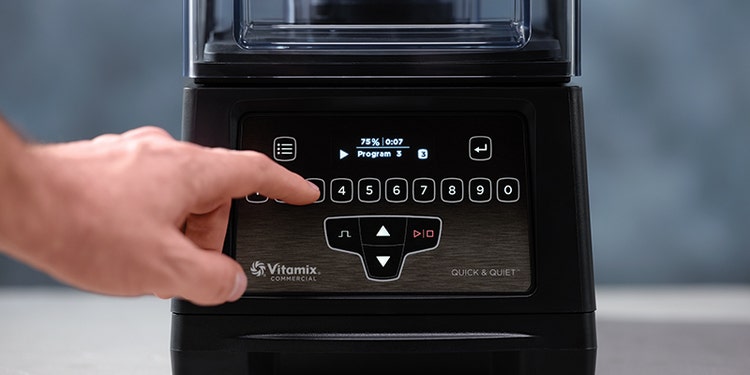
Programmable settings can simplify preparation by allowing employees to use established blending programs for repeatable recipes. This can be particularly useful in operations with multiple employees, frequent orders, or standardized menu items.
Programs do not replace accurate recipes and proper ingredient loading. When used as part of a standardized process, however, they can reduce the amount of manual attention required during a blending cycle and support greater consistency across orders.
Compact footprint
Counter space is valuable in commercial kitchens and beverage stations. A smoothie machine should fit comfortably into the intended workspace without interfering with ingredient storage, drink assembly, cleaning, or other equipment.
Consider the complete operating footprint, not only the dimensions of the motor base. Employees need sufficient space to load and remove containers and perform required cleaning and handling tasks.
Warranty and service support
Commercial equipment is an operational investment, making warranty terms and service support relevant considerations. Businesses should understand the coverage applicable to the equipment they are evaluating and how support is accessed if a problem occurs.
Review current manufacturer documentation for specific warranty terms, service options, and coverage because these details can vary by product and market.
Tips for getting the most from your commercial smoothie machine
Equipment selection is only one part of a successful smoothie program. Day-to-day operating practices can influence consistency, efficiency, cleanliness, and equipment reliability.
Train staff on proper operation
Employees should understand the correct operating procedures for the specific machine they use. Training should cover recipe execution, ingredient loading, controls, containers, cleaning, and any relevant safety procedures.
Documented processes can be especially useful when multiple employees use the same equipment or when new team members need to be trained.
Follow recommended cleaning procedures
Follow the manufacturer's current instructions for cleaning and sanitizing the machine and its components. Foodservice operators should also comply with applicable food-safety requirements for their operation.
Consistent cleaning procedures help employees know what needs to be done between uses and at closing, while reducing uncertainty about how equipment components should be handled.
Use the right container for each application
Where different containers or configurations are available for different applications, use the option recommended for the task. Container selection can affect capacity, workflow, and how effectively a recipe is processed.
Employees should be trained to recognize which equipment is appropriate for each menu application rather than improvising during service.
Perform routine maintenance
Regular inspection and maintenance can help identify wear or operational issues before they disrupt service. Follow the manufacturer's guidance for the specific commercial machine and replace components when appropriate.
Staff should also know how to report changes in equipment performance so potential problems are not overlooked during busy shifts.
Frequently asked questions about commercial smoothie machines
What is the difference between a commercial and residential smoothie machine?
A commercial smoothie machine is designed for professional foodservice applications and the operating demands associated with them. Commercial businesses may require repeated blending cycles, standardized preparation across multiple employees, commercial service support, and equipment intended for use in a foodservice environment.
Residential machines are designed around household use. Businesses should choose equipment specifically intended and supported for their commercial application rather than assuming a household machine will meet professional operating requirements.
How long do commercial smoothie machines last?
There is no single lifespan that applies to every commercial smoothie machine. Service life depends on factors including the specific equipment, workload, recipes, operating practices, cleaning, maintenance, and replacement of wear components.
Businesses comparing machines should review current manufacturer documentation, warranty information, and maintenance recommendations rather than relying on a generalized lifespan estimate.
Can commercial smoothie machines crush ice and frozen fruit?
Commercial smoothie machines designed for smoothie applications may be capable of processing ice and frozen fruit, but capabilities depend on the specific model, container, recipe, ingredient quantities, and operating instructions.
Businesses that regularly use frozen ingredients should confirm that the machine under consideration is intended for those applications and follow the manufacturer's recommended procedures.
What size commercial smoothie machine is best for my business?
The best size depends on drink volume, recipe portions, menu requirements, available space, and workflow. A high-volume juice bar may prioritize different capacity and throughput considerations than a restaurant that prepares smoothies occasionally.
Start with actual serving sizes and peak-period demand. Then consider how many drinks employees need to prepare consecutively, how much counter space is available, and which container capacities are appropriate for the menu.
Find the right commercial smoothie machine for your business
Choosing a commercial smoothie machine starts with understanding the operation it needs to support. Daily and peak drink volume, menu ingredients, durability, cleaning, noise, available space, programmable controls, and service support can all influence the decision.
The strongest choice is equipment that fits naturally into the business's workflow while providing the performance required for its recipes. Staff training, proper cleaning, appropriate container use, and routine maintenance can then help support consistent operation over time.